
- What is the aim of therapy for ulcerative colitis?
- What factors influence the treatment decision?
- Treatment of mild to moderate ulcerative colitis
- Treatment options for mild to moderate ulcerative colitis - an overview
- New therapeutic approaches & future developments
- Conclusion: Which therapy is right for me?
- Frequently asked questions about the treatment of ulcerative colitis
- Sources
The treatment of ulcerative colitis (UC) has several objectives. Firstly, the inflammation in the intestine should be reduced and secondly, the symptoms should be alleviated. The therapy also aims to achieve long-term remission. Ideally without the use of corticosteroids. What treatment options are there and how are they individually adapted based on the course and severity of the disease? In this article, you will find out everything about Modern therapeutic approaches for ulcerative colitisbased on the current S3 guideline on the diagnosis and treatment of CU
What is the aim of therapy for ulcerative colitis?
Currently there are No cure for ulcerative colitis. The main aim of the therapy is to
- A quick clinical remission (freedom from symptoms).
- The Endoscopic remission (no visible inflammation in the intestine).
- The Use of corticosteroids or to avoid them altogether.
What factors influence the treatment decision?
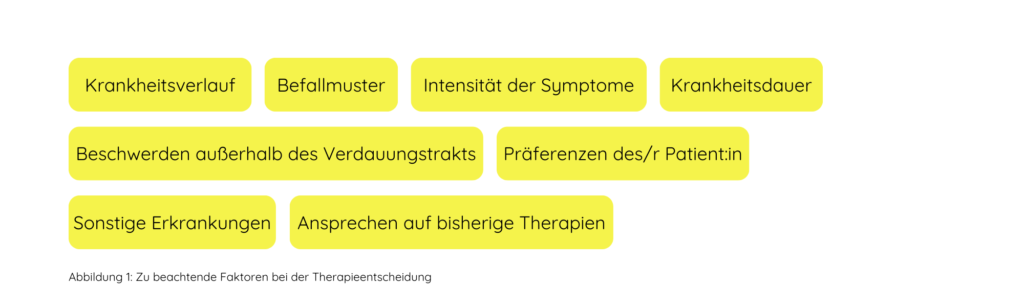
The selection of right therapy option is a joint decision between doctor and patient. In addition, side effects experienced with previous therapies and the severity of the condition play a key role in the treatment decision.
Treatment of mild to moderate ulcerative colitis
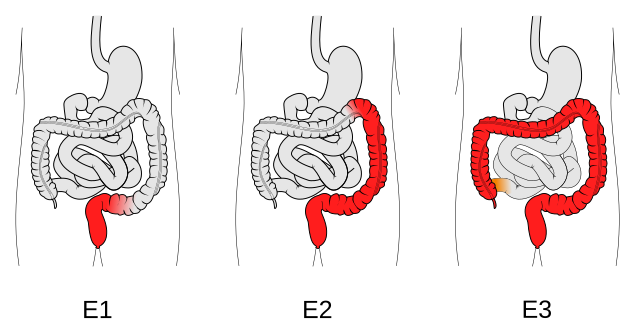
Depending on the infestation pattern, a distinction is made between CU:
- E1: Proctitis (only rectum affected)
- E2: Left-sided colitis (left half of the abdomen affected)
- E3: Extensive infestation (entire large intestine affected)
1. Thrust therapy for a Proctitis
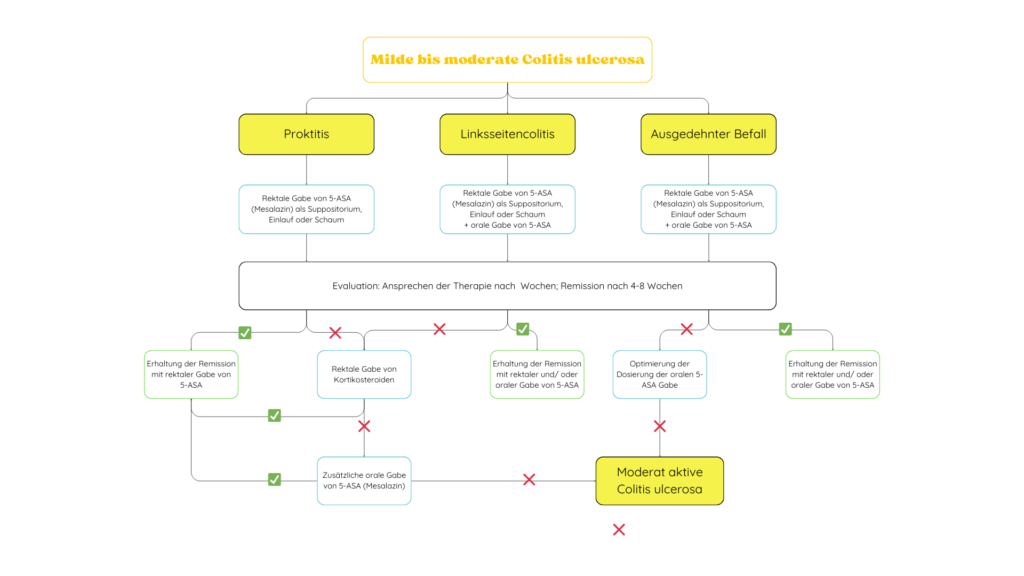
The drug of choice for mild to moderate proctitis is initially the administration of mesalazine as a suppository ("suppository"). Alternatively, doctors also use mesalazine in the form of foams and enemas.
If rectal therapy alone does not achieve the desired effects, the treatment can be adapted accordingly. For example, either topical corticosteroids (e.g. budesonide rectal foam) or additional oral mesalazine can be added.
 Topical corticosteroidsTopical corticosteroids are corticosteroids (also known as glucocorticoids, steroids or cortisone) that are used locally. Depending on the area of application, they are used in the form of sprays, drops, enemas, foams or creams. By targeting the affected area, local therapy limits the distribution in the body and thus significantly reduces the risk of side effects.
2. Relapse therapy for left-sided colitis
Doctors also recommend rectal mesalazine for mild to moderate left-sided colitis. In this context, it is used either in the form of enemas or foams. In addition, experts recommend taking oral mesalazine right from the start to make treatment more effective. If the symptoms do not improve with this therapy, the use of topical corticosteroids such as budesonide rectal foam is also recommended.
3. Relief therapy for extensive infestation
The treatment principles for extensive ulcerative colitis essentially correspond to those for left-sided colitis. If there is extensive intestinal involvement, oral mesalazine in combination with rectally administered mesalazine foams or enemas is recommended. If this therapy does not work, it is recommended to increase the dose of oral mesalazine if the infestation is extensive.
Treatment options for mild to moderate ulcerative colitis - an overview
New therapeutic approaches & future developments
In addition to the established medications, there are more and more New therapeutic approacheswhich are examined:
- Biologics & JAK inhibitors: Innovative medicines for more severe cases.
- Mesenchymal stem cell therapy: Promising research approach.
- Microbiome therapies: Influencing the intestinal flora to inhibit inflammation.
Important innovations in the S3 guideline 2024
The current S3 guideline on ulcerative colitis (June 2024) contains several important changes:
- New therapy options included:
- Upadacitinib and mirikizumab were included in the guideline for the first time.
- The guideline adds a recommendation for patients who do not respond adequately to aminosalicylates.
- The guideline specifies the dosage and use of TNF antibodies for complicated courses.
- Therapy of complicated forms of progression revised:
- The S3 guideline specifies the treatment recommendation for patients with steroid-dependent ulcerative colitis. It now recommends early escalation of therapy with Biologics or JAK inhibitors recommended.
- New focus on individualized therapy:
- The guideline again emphasizes the importance of patient-specific factors such as the course of the disease, concomitant diseases and the response to previous therapies.
Conclusion: Which therapy is right for me?
- Choosing the right therapy depends on the course of your illness, the severity of your symptoms and individual factors.
- Mesalazine remains the standard therapy for mild to moderate courses.
- Corticosteroids should only be used for a short and for severe relapses.
- New drugs & biologics are used in more severe cases.
Speak to your doctor about the options available to you. Best therapy option!
Find out more?
💡 Read more about the latest findings on IBD therapy here: Mesenchymal stem cells - new hope for IBD sufferers
Frequently asked questions about the treatment of ulcerative colitis
Can ulcerative colitis be cured?
Many patients achieve long-term freedom from symptoms with the right therapy, but a cure is not possible.
What should I do if my medication doesn't work?
Talk to your doctor about a Adaptation of the therapy or the use of newer drugs.
Are biologics better than mesalazine?
Not necessarily - they are for Severe courses while mesalazine is often sufficient for mild cases.
Is there a special diet that helps?
A targeted diet can indeed have a supportive effect. However, it does not replace medication. You can find out more about this in our article on CED nutrition.
Sources
German Society for Gastroenterology, Digestive and Metabolic Diseases (DGVS). (2024). S3 guideline on the diagnosis and treatment of ulcerative colitis (version 2024-06). AWMF Registry No. 021-009. Z Gastroenterol 2024; 62: 769-858 DOI 10.1055/a-2271-0994
 Deutsch
  English
  Español
  Français
  Português