

Heart rate variability (HRV) - What is it?
- Heart rate variability, or HRV for short, reflects the heart's ability to adapt to different situations and provides information on the Well-being and the General health one person.
- HRV is linked to the autonomic nervous system (ANS). With the help of the ANS, the body adapts to different environmental conditions and changing stress levels. A higher HRV stands for Recovery and regenerationa lower HRV for Increased activity and performance.
- HRV is unique to each person and depends on many different factors. Some of these factors can be influenced, others cannot.
Definition & Bedeutung der Herzratenvariabilität
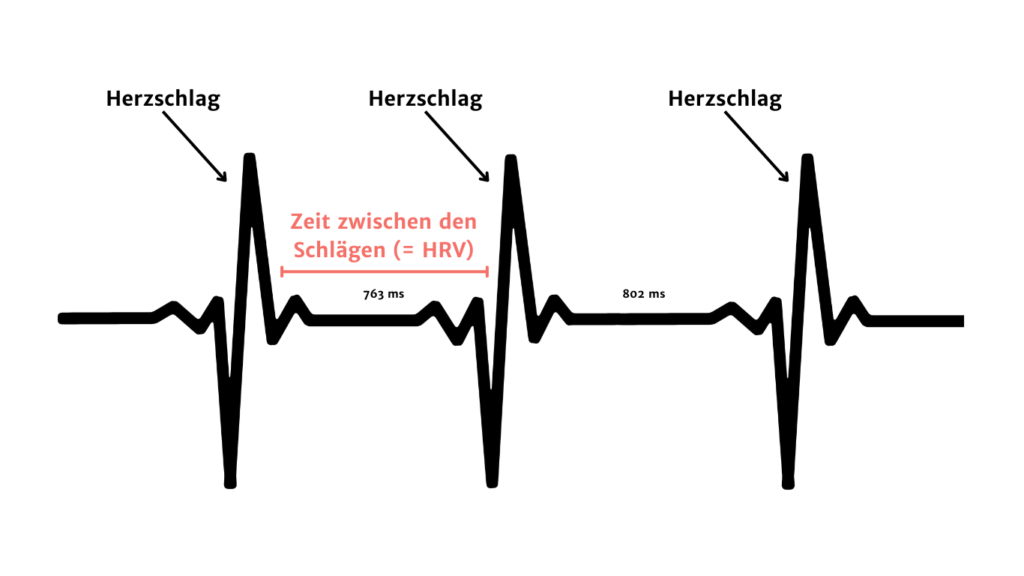
Everyone knows the saying "My heart beats like Swiss clockwork", which implies that a healthy heart follows a steady rhythm. However, a healthy heart actually changes its rhythm with every single beat. This means that a different number of milliseconds elapse between each heartbeat. These Variation of milliseconds is referred to as heart rate variability, or HRV for short.
The higher these variations are, i.e. the more different the number of milliseconds between heartbeats, the higher the HRV. If the time intervals between beats remain more constant, the HRV is lower.
Warum ist die Herzratenvariabilität ein wichtiger Gesundheitsindikator?
We are not consciously aware of the millisecond fluctuations between heartbeats, but they reflect our heart's ability to react to different situations.
HRV is one of the first to react to stress or illness, which makes it one of the most meaningful signals from your body and provides helpful insights into your recovery, well-being and health.
How exactly does HRV work?
Connection to the autonomic nervous system (ANS)
The HRV is connected to the autonomic nervous systemANS for short. This consists of the parasympathetic nervous system (parasympathetic nervous system) and the sympathetic nervous system (sympathetic nervous system).
The Sympathetic nervous system is responsible for the body reacting immediately to stress or a threat. It leads to a Increased activity and performance ("Fight or Flight") and makes the heart beat faster and the blood flow to the muscles stronger.
The body needs to recover after every stressful situation. The Parasympathetic nervous system is responsible for rebuilding the reserves that have been used up and promotes Rest, relaxation and regeneration ("Rest and Digest").
- Sympathetic nervous system ("Fight or Flight"): Reduziert die Herzratenvariabilität, aktiviert den Körper in Stress- oder Gefahrensituationen
- Parasympathetic nervous system ("Rest & Digest"): Erhöht die Herzratenvariabilität, fördert Regeneration & Entspannung
Together, the sympathetic and parasympathetic nervous systems regulate and control important organ functions, such as the heart and respiratory rate, the digestive system and the metabolism, thus ensuring a healthy and healthy body. Balance.
As HRV is directly connected to the autonomic nervous system, i.e. also the sympathetic and parasympathetic nervous systems, the balance of the ANS can be assessed well via HRV.
Sympathikus vs. Parasympathikus – Was bedeutet das für deine Herzratenvariabilität?
- One higher HRV is associated with rest and regeneration, general fitness and good recovery. Here, the parasympathetic nervous system instructs the heart to beat more slowly to make room for the variability between heartbeats (= greater differences in the milliseconds between beats).
- One lower HRV is associated with "fight-or-flight" reactions, increased stress, illness or excessive physical exertion. Here, the sympathetic nervous system instructs the heart to speed up. This restricts the space for variability between heartbeats (= smaller differences in the milliseconds between beats).
Why is HRV so individual?
Wichtig zu beachten ist, dass eine „hohe“ oder „niedrige“ Herzratenvariabilität sehr individuell sind und sich von Person zu Person unterscheiden. Die Herzratenvariabilität ist eine Highly sensitive measured variablewhich reacts differently in every person.
So don't compare your values with the HRV values of others, but concentrate on your own HRV values. own average values. In addition, it is also normal for HRV to vary daily and seasonally. Fluctuations is subject to.
Welche Faktoren beeinflussen deine Herzratenvariabilität?
Dabei gibt es verschiedene Faktoren, die das autonome Nervensystem und dadurch auch die Herzratenvariabilität beeinflussen können. Auf einige dieser Faktoren kannst du Einfluss nehmen, auf andere nicht.
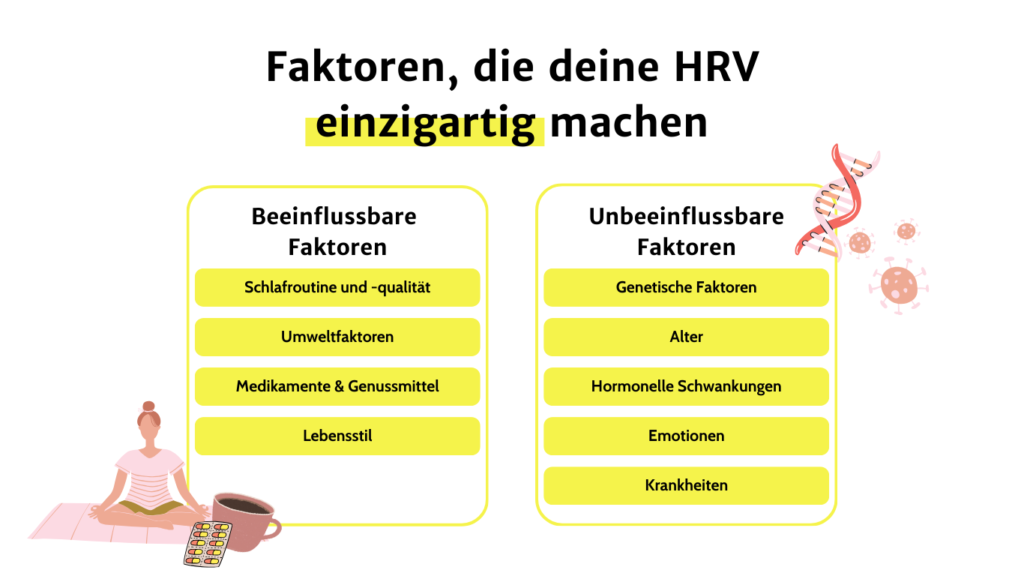
Factors that you cannot influence
1. genetics
Your genetic predisposition plays the main role in determining your baseline HRV, i.e. your normal values. Every person has unique genes and therefore a unique autonomic nervous system. This leads to individual differences in HRV patterns. You may therefore naturally have higher or lower HRV values.
2. age
Die Herzratenvariabilität verändert sich mit dem Alter. Je älter eine Person ist, desto niedriger ist normalerweise auch die HRV. Dieser Rückgang der Herzratenvariabilität wird auf unterschiedliche age-related changes of the ANS.
3. hormonal fluctuations
The body's own hormonal cycles haben ebenfalls einen Einfluss auf die Herzratenvariabilität. Dies betrifft vor allem Frauen, da v.a. der Menstrual cycle das autonome Nervensystem und damit auch die Herzratenvariabilität beeinflusst. Veränderungen der Herzratenvariabilität in verschiedenen Phasen des Menstruationszyklus sind daher nichts Ungewöhnliches.
4. emotions
Auch wenn wir achtsam und reflektiert mit unseren Gefühlen umgehen, so lassen sich unsere Emotionen nicht wirklich kontrollieren. Emotionen wie Fear or excessive demands can lower HRV, indicating that we are not as resilient as normal at the moment. On the other hand Positive emotions and relaxation die HRV erhöhen. Unser Nervensystem ist dann besonders flexibel und widerstandsfähig, was sich in der Herzratenvariabilität widerspiegelt.
5. illness
Krankheiten und Gesundheitsprobleme können die Herzratenvariabilität ebenfalls beeinflussen. Während einer Erkrankung reagiert der Körper auch den physiological stress, was die Herzratenvariabilität senken kann.
Factors that you can influence
1. sleeping habits
Also your Sleep quality and your Sleep-wake rhythm können die Herzratenvariabilität beeinflussen. Ein ausreichender und erholsamer Schlaf kann zu einer höheren HRV führen, während Schlafstörungen und Schlafentzug negativ auf die Herzratenvariabilität wirken. Mit einer good sleep routinewhich adapts to your personal, natural rhythm, you can positively influence your HRV.
To find the right sleep routine for you, it can help to know your own chronotype, e.g. whether you are more of a morning person or a night person. You can find various tests online for this.
coreway tip
2. environmental factors
Environmental factors, such as the Ambient temperature and Height or the Air quality can also influence HRV.
3. medicines and stimulants
Medikamente und Genussmittel beeinflussen unser autonomes Nervensystem und dadurch auch unsere Herzratenvariabilität. Stimulants such as caffeine, for example, increase the activity of the sympathetic nervous system and can therefore lead to a lower HRV.
If you measure your HRV after drinking caffeine, your values will most likely be distorted. It is therefore best to make sure that you have not consumed any caffeine before your measurements. It is best to take the measurement directly after waking up.If the measurement is taken during the day, it is at least influenced by external factors. You can then also use this measurement for the input in the app.
coreway tip
4. lifestyle
All deine Lebensgewohnheiten tragen zu deiner individuellen Herzratenvariabilität bei. Du hast also durchaus eine gewisse Kontrolle über deine eigene HRV. Für eine ausgeglichene HRV kannst du dich vor allem auf folgende Lebensgewohnheiten konzentrieren: Schlafqualität, körperliche Aktivität, Stressbewältigung, ausreichende Flüssigkeitszufuhr und Ernährungsgewohnheiten.
Normwerte- Wie hoch ist eine „gute“ Herzratenvariabilität?
As already explained, HRV varies from person to person and in adults can range from 20 to 200 ms are sufficient. If you measure your HRV regularly, preferably overnight, you can determine your own baseline values.
Schwankungen der Herzratenvariabilität sind durch die vielen Einflussfaktoren ganz normal. Deshalb ist eine Messung über Nacht auch besonders wertvoll. Hier befindet sich der Körper in einem constant state without disruptive variables, such as stressful situations, social interactions or a changing environment.
Die meisten wearables ermöglichen eine Messung der Herzratenvariabilität über Nacht. Bei der Apple Watch lässt sich dies bspw. auch in den Einstellungen aktivieren. Wenn du Questions about night-time measurement with your wearable, then feel free to contact us at kontakt@core-way.de.
We hope this article has given you a good overview of HRV. We would be delighted to receive a review!
Literature
- Team, O. (2024, February 7). What is Heart Rate Variability (HRV)? The Pulse Blog. https://ouraring.com/blog/what-is-heart-rate-variability/
- I care Anatomy Physiology. (2020). https://doi.org/10.1055/b-006-163254
If you are interested in how stress affects your IBD, read our article: Relaxation with CED - The best techniques for coping with stress
 Deutsch
  English
  Español
  Français
  Português